Douglas Richardson's Thoughts on The M Series 60
09th October 2026
In: Short Stories, News
The Stainless-Steel Leica - A Flawed Masterpiece
by Douglas Richardson
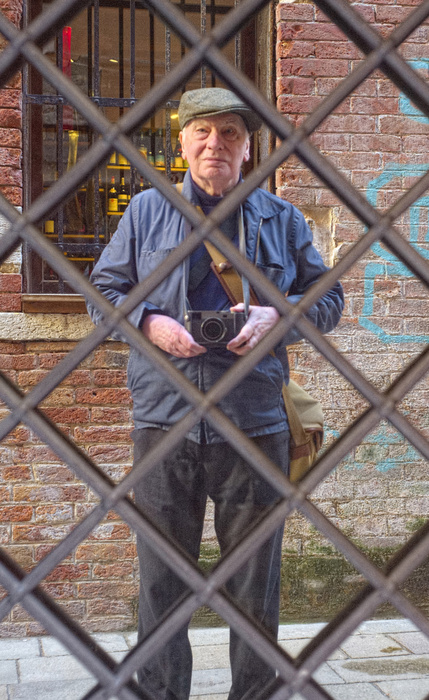
In Shakespeare's play 'Julius Caesar', Brutus tells Cassius that "the eye sees not itself, but by reflection". I thought of these words when on holiday in Venice two years ago with what was then my newly-acquired Leica Series 60 camera. Walking down a narrow lane in that city's Castello district, I was surprised to catch a glimpse of myself in a mirror visible through a window. So I stopped, and decided to record the reflected scene.
My slightly-askew cap was not the result of over-indulgence in lunchtime wine, but had been positioned to make it easier for me to hold the camera to my eye. However the presence on my camera of a standard production Leica lens rather than the customised 35mm Summilux variant that had originally formed part of the Series 60 boxed set was a result of a previous owner having decided to sell the camera, but to keep the lens.
Both items had been restyled by Audi and incorporated metalwork made of stainless steel, a material on which Wetzlar had applied a novel finish that can best be described as having an appearance that falls between that of silver and titanium.
It might be nice to see my Series 60 camera teamed once again with the correct pattern of lens, but this is unlikely to happen. Given that it uses the optics of the widely-available 1994-2009 ASPH version of the Summilux, but is some 120g heavier due to its steel construction, I would have expected the Series 60 lens to be relatively unattractive to anyone who does not own a Series 60 camera. However the few examples that have been offered for sale on the international market have had eye-watering prices.
There is a down side to the Series 60 Leica. Its firmware has never been updated, and can only be described as crude – the DNG files that are the camera's only output format are not compressed. Although the introduction of correction profiles and coding marks for each type of modern lens had been a major feature introduced by the Leica M8 some six years earlier, with the Series 60 camera a single correction profile is used for all lenses whether these are coded lenses or uncoded.
The first regular production model of a screenless digital Leica was the M-D Type 262 introduced in 2016. This had firmware that incorporated DNG file compression and used lens correction profiles, but these features were never provided as an update for the Series 60 camera. Presumably Wetzlar had assumed that the latter were destined to sit in collector's display cabinets rather being used to take photographs, so there was no need to provide updated firmware.
Sorry Wetzlar – I use my Series 60 camera, and have no plans to replace it. To borrow words from the late Charlton Heston, "From my cold dead hands...".
Gerald Stone has now arranged the visit to the new London store, details are below:
The visit to the New Leica Mayfair Flagship Store at 14 Dover Street, W1S 4LW, is now arranged for the afternoon of 28th January 2027. I am still working on the details for the day, but I am hoping for a tour of the new facilities and also a visit to the new Customer Care centre in Soho along other things.
If you want to go on this visit please contact Gerald on his email address:
gm_stone@btinternet.com
I still have a couple of vacancies as numbers are limited so come back to me quickly if you want to join the day - acceptance will be on a first-come-first-served basis. I’ll look forward to hearing from you.
by Douglas Richardson
In Shakespeare's play 'Julius Caesar', Brutus tells Cassius that "the eye sees not itself, but by reflection". I thought of these words when on holiday in Venice two years ago with what was then my newly-acquired Leica Series 60 camera. Walking down a narrow lane in that city's Castello district, I was surprised to catch a glimpse of myself in a mirror visible through a window. So I stopped, and decided to record the reflected scene.
My slightly-askew cap was not the result of over-indulgence in lunchtime wine, but had been positioned to make it easier for me to hold the camera to my eye. However the presence on my camera of a standard production Leica lens rather than the customised 35mm Summilux variant that had originally formed part of the Series 60 boxed set was a result of a previous owner having decided to sell the camera, but to keep the lens.
Both items had been restyled by Audi and incorporated metalwork made of stainless steel, a material on which Wetzlar had applied a novel finish that can best be described as having an appearance that falls between that of silver and titanium.
It might be nice to see my Series 60 camera teamed once again with the correct pattern of lens, but this is unlikely to happen. Given that it uses the optics of the widely-available 1994-2009 ASPH version of the Summilux, but is some 120g heavier due to its steel construction, I would have expected the Series 60 lens to be relatively unattractive to anyone who does not own a Series 60 camera. However the few examples that have been offered for sale on the international market have had eye-watering prices.
There is a down side to the Series 60 Leica. Its firmware has never been updated, and can only be described as crude – the DNG files that are the camera's only output format are not compressed. Although the introduction of correction profiles and coding marks for each type of modern lens had been a major feature introduced by the Leica M8 some six years earlier, with the Series 60 camera a single correction profile is used for all lenses whether these are coded lenses or uncoded.
The first regular production model of a screenless digital Leica was the M-D Type 262 introduced in 2016. This had firmware that incorporated DNG file compression and used lens correction profiles, but these features were never provided as an update for the Series 60 camera. Presumably Wetzlar had assumed that the latter were destined to sit in collector's display cabinets rather being used to take photographs, so there was no need to provide updated firmware.
Sorry Wetzlar – I use my Series 60 camera, and have no plans to replace it. To borrow words from the late Charlton Heston, "From my cold dead hands...".
Gerald Stone has now arranged the visit to the new London store, details are below:
The visit to the New Leica Mayfair Flagship Store at 14 Dover Street, W1S 4LW, is now arranged for the afternoon of 28th January 2027. I am still working on the details for the day, but I am hoping for a tour of the new facilities and also a visit to the new Customer Care centre in Soho along other things.
If you want to go on this visit please contact Gerald on his email address:
gm_stone@btinternet.com
I still have a couple of vacancies as numbers are limited so come back to me quickly if you want to join the day - acceptance will be on a first-come-first-served basis. I’ll look forward to hearing from you.
Comments
 By Cled Lewis: Hello Douglas,
I consider myself to be fortunate to own an M60 like you, it is a beautiful piece of kit.
The stainless steel is unique but as you said heavier than the conventional M..
I have never considered it a problem because it is still probably lighter than the SL.
I do have the original lens which is my “go to” lens and I can understand why owners are reluctant to part with it.
I use the camera but not as my every day model.
I agree with you that it is a keeper. By Keith Walker: Interesting read, Doug. Using this 'special' is clearly an extra challenge you enjoy, and long may it be so. By David Askham: Intriguing Douglas.Is it your everyday camera? In your self-portrait, you look like you are behind bars! Just joking. By Douglas Richardson: Thanks for your comments on the Series 60 lens, Cled, but to my eyes it lacks the charm of Audi's restyled camera. Last week I decided not to look for a Series 60 lens, so went to London with the intention of buying the silver variant of the current 35mm Summilux FLE. However it seemed a good idea to take a look at a used example of the previous (2010) silver FLE version. After trying both lenses on my camera to see how well-balanced the combinations were, how both lenses handled, and the degree to which they intruded into the viewfinder frame, much to my surprise I preferred the previous pattern. So in a few weeks time, my Series 60 camera and this new-to-me lens will be off to Venice...
Keith - I don't see the Series 60 as a challenge. It's a welcome simplification that reminds me of the film era. I see a potential pic, raise the camera, frame the scene, check the focus and exposure, press the shutter release, lower the camera, and go back to 'groking' my surroundings (with apologies to Robert Heinlein, who invented the term). Looking through photos taken during a group outing a couple of years ago, about half a dozen showed my fellow photographers, but in only one of these pics could someone been seen using their camera to take a photo - in all the others, folks were not taking pics but seemed to be 'chimping'. I'm not a very good photographer, but when 'out and about' with my camera, I want to concentrate on seeing and recording, and not on camera rear screens and the surrounding controls.
David - Yes, the Series 60 is now my regular camera. For some years my main camera was an M8.2, then an M9-P. I've always preferred silver cameras but started my 'screenless' existence with an M-D, a version that was only available with a black-paint finish. When a Series 60 body was offered for sale in 2024, I wondered if stainless steel might prove an acceptable alternative to silver, went to look at it, and fell in love with it on the spot.