A Lone Swallow - David Askham 2026
25th June 2026
In: Short Stories, News
A Lone Swallow
By
David Askham
By
David Askham
A picture can rarely tell a whole story; but it can pose questions which an enquiring mind might answer. That is where additional words, by the photographer, can really help. Words can give added information that rewards and informs a reader. So, what is the story behind this rare sighting of a young juvenile swallow, perched on our television antenna, in late summer, a year or two ago?
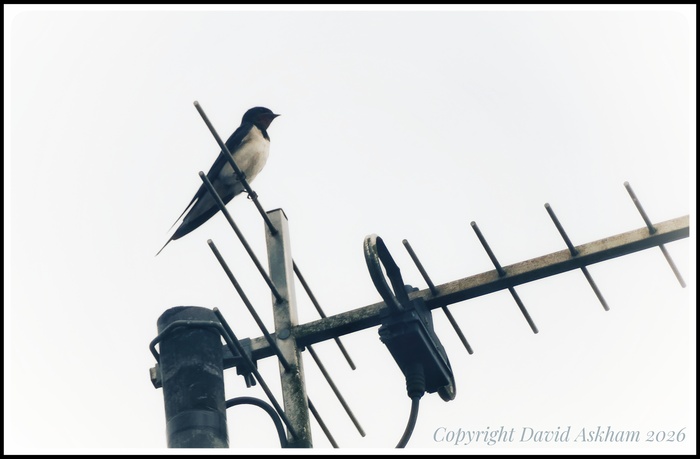
This tiny bird's distant ancestors probably spent their summers in this former Victorian farmyard, long before television was invented. Flying insects would have been ever-present at this old dairy farm, one of many small farms in our tiny hamlet, which have long since disappeared.
Airborne flies would have been the sole diet of these acrobatic birds, who entertained us endlessly on summer evenings, with their balletic cavorting in the skies above our peaceful garden, while we enjoyed a refreshing drink.
DIY nest maintenance
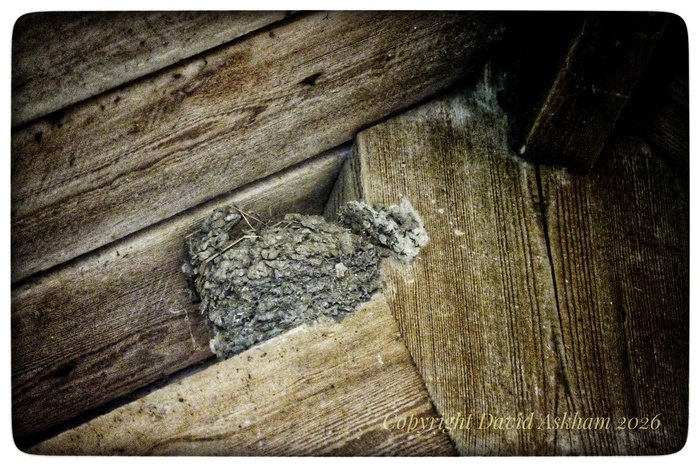
Remains of a swallows' nest in a dark outbuilding, in murky low-light).
(Leica V-Lux Typ.114 ISO 12,500, 365mm 1/20th second f/4.0, hand-held).
Their appearance in early May would see a short period of nest repair work before the first of two or three broods were born by our Bromham-based birds. Progressively, the skies above our home would be filled by these masters of aerial feeding, as the fledglings learned to fly and fend for themselves.
Just consider the fact that each swallow can catch and consume up to 850 flying insects per day! Their aim is to build up their body strength in order to fly up to 6,000 miles to South Africa where they spend their winters. Just think of that monumental effort.
Averaging about 200 miles in a day, those tiny birds, merely 19 grams on average in weight, take approximately 6 weeks to reach their destination, often through hostile conditions. I will leave you to estimate the numbers of wing-beats that distance entails!
So what about the youngster perched on our TV aerial? He belongs to the last of the broods to be born on our premises. His parents and older siblings have already left our place and are probably well on their way to their wintering quarters. He and his equally late siblings have delayed their departure in order to build up energy and body mass to survive the long journey.
But wait a minute. How do they know the way?
No SATNAV available
It is believed that, embedded in their brains, are the requisite instructions to enable them to find their destinations. Somehow they know the direction and distance they have to fly. Isn't 'Mother Nature' simply stupendous?
The long reach of my Leica V Lux (typ. 114) zoom lens enabled me to capture this moment from a quiet shaded spot on our patio.
Here today. Gone tomorrow!
So there you have it: one picture and one back story. (With two supporting pictures as a bonus!)
Sadly, with climate change, and lost or changing farming practices, our swallows no longer make their summer homes with us. We think they may have gone further north. But their presence in Bromham has been immortalised. Their old slowly crumbling nests remain in our outbuildings.
'Spring Watch', look out for competition from members of The Leica Fellowship!
*******
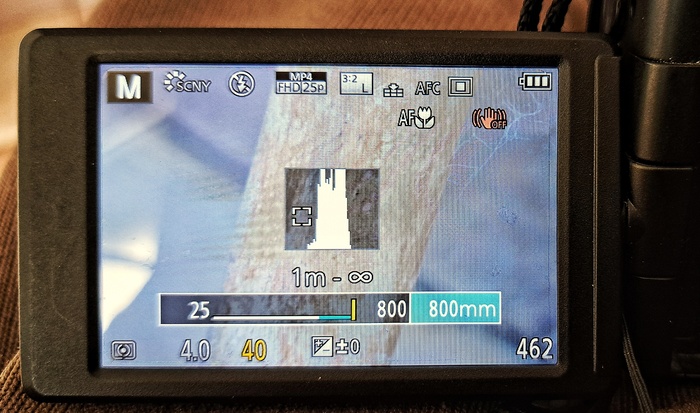
[Extra note on zooming with Lumix (or V Lux) cameras. I-Zoom, or Intelligent Zoom, uses image processing software to increase zooming while trying to maintain image sharpness. It usually provides up to 2× magnification and is a capability owners should become familiar with. It only works with jpeg files, unfortunately, but can be superior to Digital Zooming. Why not try it?
The image above shows the virtual extension in blue. My illustration of the swallow did not need an iZoom setting. But I have used it on other occasions. It is a potentially useful facility to have in reserve or for appropriate situations. I occasionally use it to help me identify birds or small mammals visiting our garden, or just visible in the fields beyond].
(Copyright David Askham 2026)
Comments
 By Keith Walker: Nice little fact packed story, thank you David. I find the story of any migratory bird an awesome facet of nature. By Ken Davis: David,
thank you for this article, it shows other members that it is quite simple to create an article and tell a story.
Your story reminds me of my youth and seeing dozens of starlings on telegraph wires resting between feeds to get strong enough to migrate.
We don't see any swallows or house martins and we used to have two nests of martins on our house.
Your comment is so apt:
Here today, gone tomorrow......forever! By Cled Lewis: As usual from you David, a fascinating article on a seemingly simple subject, an enjoyable read with so much information.
It reminded me of my boyhood playing “down the river” where there were dozens of swifts so fast and so agile. I don’t remember swallows though.
Thank you for rekindling memories. By Alan Humphries: The V Lux did you sell Davids An interesting piece David particularly the fact the swallows have deserted you. I have had wrens in my garden ever since I have lived here 50 years,next month (it's called inertia) but year no sign at all.
Could this also be climate change? By David Askham: Thank you Alan. Wrens are secretive and elusive little birds. Like you we had a constant presence of wrens until recent years. We missed them until we happened to spend time near our woodstore. Then, suddenly, we noticed that we were in their flight path and we were elated. They had young nearby, so we moved away. By David Askham: Keith, we have so much to learn about navigation from migratory birds, if only we could crack their code! By David Askham: Ken and Cled, thanks for your kind and relevant comments. Pictures can trigger memories from earlier times, times we thought would never change. Shirley and I were sitting outside in the cooler evening air, just around sunset, when we saw several swallows airborne. We were on the outer edge of their flight circuit. So they are definitely elsewhere in the village. Our spirits were lifted.
By Keith Walker: Nice little fact packed story, thank you David. I find the story of any migratory bird an awesome facet of nature. By Ken Davis: David,
thank you for this article, it shows other members that it is quite simple to create an article and tell a story.
Your story reminds me of my youth and seeing dozens of starlings on telegraph wires resting between feeds to get strong enough to migrate.
We don't see any swallows or house martins and we used to have two nests of martins on our house.
Your comment is so apt:
Here today, gone tomorrow......forever! By Cled Lewis: As usual from you David, a fascinating article on a seemingly simple subject, an enjoyable read with so much information.
It reminded me of my boyhood playing “down the river” where there were dozens of swifts so fast and so agile. I don’t remember swallows though.
Thank you for rekindling memories. By Alan Humphries: The V Lux did you sell Davids An interesting piece David particularly the fact the swallows have deserted you. I have had wrens in my garden ever since I have lived here 50 years,next month (it's called inertia) but year no sign at all.
Could this also be climate change? By David Askham: Thank you Alan. Wrens are secretive and elusive little birds. Like you we had a constant presence of wrens until recent years. We missed them until we happened to spend time near our woodstore. Then, suddenly, we noticed that we were in their flight path and we were elated. They had young nearby, so we moved away. By David Askham: Keith, we have so much to learn about navigation from migratory birds, if only we could crack their code! By David Askham: Ken and Cled, thanks for your kind and relevant comments. Pictures can trigger memories from earlier times, times we thought would never change. Shirley and I were sitting outside in the cooler evening air, just around sunset, when we saw several swallows airborne. We were on the outer edge of their flight circuit. So they are definitely elsewhere in the village. Our spirits were lifted.