"Natural Elegance" by David Askham (2026)
30th August 2026
‘Natural Elegance’ by David Askham (2026)
During the recent summer of heatwaves, while enjoying a moment in the shade, frankly, my primary aim was one of personal survival. To keep breathing in the very hot and humid conditions.
My thoughts ranged far and wide, wondering whether we would ever experience wet and windy weather ever again. Remember, we had gone around two months with not a rain-cloud in sight in the southern half of the UK. Human energy was diminished, especially for the elderly in our communities.
I scarcely expected to encounter any photo-opportunities. But my eye was caught by a container of recently collected weeds and dead stuff. One of the garden casualties was a dwarf self-seeded grass that had withered and died in the heat. Yet in that moment, when it caught my eye, the sun illuminated it, showing it alone against a darker background, I thought that it was promising and I pondered on the photographic possibilities.
I knew that I would need a lens with long reach, if I was to isolate my subject. A V-Lux would be perfect for my experiment, with its long adjustable focal-length. It extended from wide-angle to 400mm optically, even 800mm with iZoom. So a Leica V-Lux camera was collected and I resettled into my reclining seat.
Initial camera settings gave promising results, but nothing dramatic. The background was obstinately intrusive with glaring out-of-focus highlights; and the main subject suffered from burned-out bright parts. Nothing appealed. So, I decided to leave everything in place, except the camera, until later that day, when I knew that the subject would be back-lit and it might be a bit cooler. And it was.
Importantly, the background was now in shade. Perfect for what I had in mind. Straight metering resulted in no part of my subject being satisfactorily exposed. So I started a series of incremental reductions in -⅓ EV steps. I found that I needed at least -2.0 EV reduction; but nearly -3.0 EV was even more dramatic.
(With Leica-designed camera bodies, it would be much easier to manage exposure compensation by using manual mode. Alternatively, with Panasonic-designed cameras, use of dedicated controls tends to be easier and easily becomes a habit.) The choice is entirely personal. Here is my result.
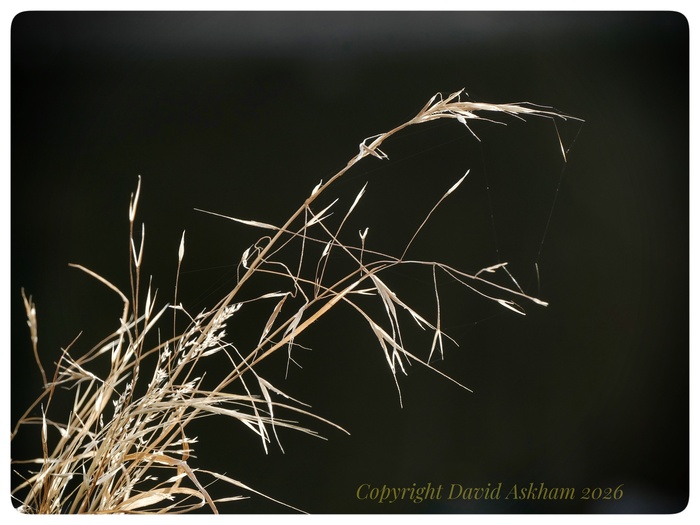
'Natural Elegance‘ seen and captured during a recent heatwave while seeking sanctuary in the shade. (V-Lux Typ114, Leica Vario-Elmarit lens optically zoomed to 351 mm, ISO 125, 1/160th f/6.3, -2.7 EV, stabilisation ‘on’)
Such a photographic situation can teach you so much. There was the chaotic randomness in the plant's growth, yet when isolated, you notice more of the various natural elements. See how such slender stems succeed in supporting flowering and seed production, regardless of winds, ever-changing air currents and ravages of the gardener who pulled them from a pot in pursuit of garden maintenance. Look at its surving graceful curves. Yet it was merely just a few blades of plucked parched grass.
By careful framing and lens zooming I was able to align the elements and maximise the contrast between subject and background, giving it an impressive, possibly dramatic status. Beauty in nature is all around us if we are open and willing to ‘see’ the evidence.
So I leave you with a simple question. Have you noticed or captured any promising subjects while sheltering from dangerous sun beams? If so, please share them with other members via the website.
During the recent summer of heatwaves, while enjoying a moment in the shade, frankly, my primary aim was one of personal survival. To keep breathing in the very hot and humid conditions.
My thoughts ranged far and wide, wondering whether we would ever experience wet and windy weather ever again. Remember, we had gone around two months with not a rain-cloud in sight in the southern half of the UK. Human energy was diminished, especially for the elderly in our communities.
I scarcely expected to encounter any photo-opportunities. But my eye was caught by a container of recently collected weeds and dead stuff. One of the garden casualties was a dwarf self-seeded grass that had withered and died in the heat. Yet in that moment, when it caught my eye, the sun illuminated it, showing it alone against a darker background, I thought that it was promising and I pondered on the photographic possibilities.
I knew that I would need a lens with long reach, if I was to isolate my subject. A V-Lux would be perfect for my experiment, with its long adjustable focal-length. It extended from wide-angle to 400mm optically, even 800mm with iZoom. So a Leica V-Lux camera was collected and I resettled into my reclining seat.
Initial camera settings gave promising results, but nothing dramatic. The background was obstinately intrusive with glaring out-of-focus highlights; and the main subject suffered from burned-out bright parts. Nothing appealed. So, I decided to leave everything in place, except the camera, until later that day, when I knew that the subject would be back-lit and it might be a bit cooler. And it was.
Importantly, the background was now in shade. Perfect for what I had in mind. Straight metering resulted in no part of my subject being satisfactorily exposed. So I started a series of incremental reductions in -⅓ EV steps. I found that I needed at least -2.0 EV reduction; but nearly -3.0 EV was even more dramatic.
(With Leica-designed camera bodies, it would be much easier to manage exposure compensation by using manual mode. Alternatively, with Panasonic-designed cameras, use of dedicated controls tends to be easier and easily becomes a habit.) The choice is entirely personal. Here is my result.
'Natural Elegance‘ seen and captured during a recent heatwave while seeking sanctuary in the shade. (V-Lux Typ114, Leica Vario-Elmarit lens optically zoomed to 351 mm, ISO 125, 1/160th f/6.3, -2.7 EV, stabilisation ‘on’)
Such a photographic situation can teach you so much. There was the chaotic randomness in the plant's growth, yet when isolated, you notice more of the various natural elements. See how such slender stems succeed in supporting flowering and seed production, regardless of winds, ever-changing air currents and ravages of the gardener who pulled them from a pot in pursuit of garden maintenance. Look at its surving graceful curves. Yet it was merely just a few blades of plucked parched grass.
By careful framing and lens zooming I was able to align the elements and maximise the contrast between subject and background, giving it an impressive, possibly dramatic status. Beauty in nature is all around us if we are open and willing to ‘see’ the evidence.
So I leave you with a simple question. Have you noticed or captured any promising subjects while sheltering from dangerous sun beams? If so, please share them with other members via the website.
Copyright Words and pictures David Askham 2026
-==@@@ &&& @@@==-
-==@@@ &&& @@@==-
Comments
 By Dennis Steel: A wonderful simple picture, it also shows patient with a camera pays off - well done David. The V-Lux is an underrated camera By Pam: Lovely photo David The light was perfect and it shows that patience pays off in the end By Cled Lewis: We have all been disturbed by the extreme weather conditions experienced over the summer and I can relate to David’s comments about breathing in the very high temperatures.
I am now able to appreciate the dialogue in old films “the rains have come”
Although we have all shared the same conditions, David has appreciated the effect on nature and set out to demonstrate it so clearly by means of our interest in photography.
The example shown together with the details of how it was achieved is beautiful.
Some people still question “global warming”
Thank you David. By Keith Walker: David has again demonstrated that you can be involved in a satisfying photographic project within our own homes.Be it the heat of summer or the depths of winter, opportunities abound. By Don Morley: Wonderful example of the seeing eye David So much more important than whatever camera one has, and a so important lesson to us all that great 'Pictures' live all around us, they just need to be seen.. Well done to you David. By David Askham: Dennis, Pam, Cled, Keith and Don, thank you for your kind comments on my heatwave picture. Greatly appreciated. Well, it did the trick; we are back to temperate times! What a relief! But it will take time for the gardens to recover. In the meantime, we can breathe more easily.
By Dennis Steel: A wonderful simple picture, it also shows patient with a camera pays off - well done David. The V-Lux is an underrated camera By Pam: Lovely photo David The light was perfect and it shows that patience pays off in the end By Cled Lewis: We have all been disturbed by the extreme weather conditions experienced over the summer and I can relate to David’s comments about breathing in the very high temperatures.
I am now able to appreciate the dialogue in old films “the rains have come”
Although we have all shared the same conditions, David has appreciated the effect on nature and set out to demonstrate it so clearly by means of our interest in photography.
The example shown together with the details of how it was achieved is beautiful.
Some people still question “global warming”
Thank you David. By Keith Walker: David has again demonstrated that you can be involved in a satisfying photographic project within our own homes.Be it the heat of summer or the depths of winter, opportunities abound. By Don Morley: Wonderful example of the seeing eye David So much more important than whatever camera one has, and a so important lesson to us all that great 'Pictures' live all around us, they just need to be seen.. Well done to you David. By David Askham: Dennis, Pam, Cled, Keith and Don, thank you for your kind comments on my heatwave picture. Greatly appreciated. Well, it did the trick; we are back to temperate times! What a relief! But it will take time for the gardens to recover. In the meantime, we can breathe more easily.