The Day I Thought My LEICA HAD DIED (David Askham 2026)
19th February 2026
In: News, Members' Articles
The day I thought my Leica had DIED! - (David Askham 2026)
OH, YES, that was a real occurrence. Not imagined. It really happened. I even considered, momentarily, what new camera I might choose to replace it. So, how did the day unfold?
Traditionally, at the start of a new year, I revisit my older and lesser-used Leica cameras. This year I chose to bring out of retirement my old D-Lux Typ.109 for a little gentle exercise. I was in for a real shock.
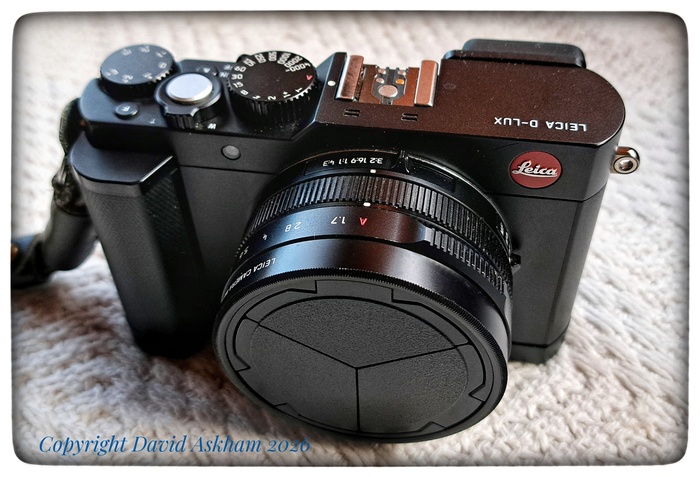
Leica D-Lux Typ.109
Why I chose this camera is another story, but briefly, I had recently enjoyed reading an old library book on landscape photography featuring the legendary Joe Cornish at work in his chosen environment. It was published 16 years ago and witnessed Joe's transition from film to digital photography. One of the cameras he used, in addition to his large format film camera, was the Panasonic Lumix equivalent of the Leica D-Lux 3, and his results were surprisingly good, frequently filling a full page or more. A master photographer appreciated the virtues and capabilities of a modest little compact camera, which just happened to be equipped with a Leica lens. Being more portable, he used it primarily for researching compositions and angles of view. I use mine as a ‘beltable’ general-purpose ‘grab and go’ sort of camera.
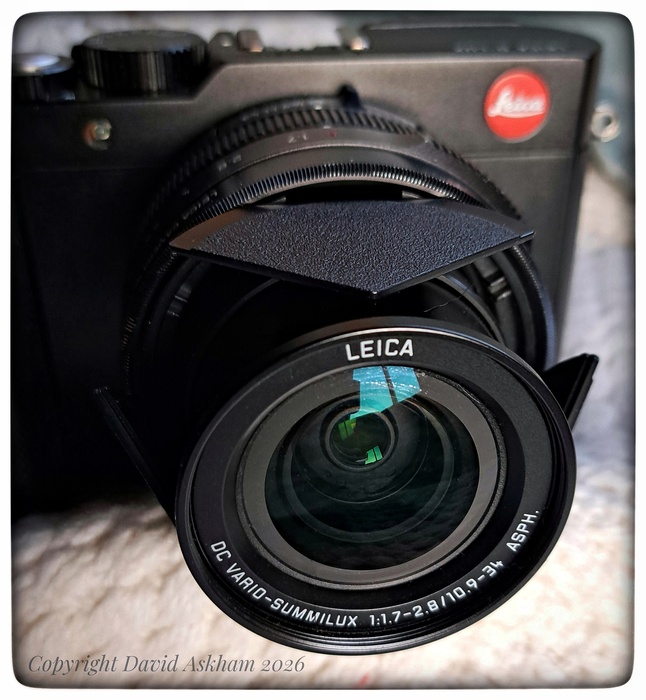
The Leica D-Lux Typ.109 is equipped with a very fine and fast Vario-Summilux lens.
The D-Lux Typ.109 is my one and only surviving member of this illustrious line, an earlier model having been given to a granddaughter, who showed interest in amateur photography. My D-Lux has served me well, was in production for many years, and frequently travelled with me prior to the Covid-19 outbreak. Less so since. But this was its day for renewed photographic activity.
Unexpected revelation
However, when I switched on the power, nothing happened. Zilch! My heart sank!
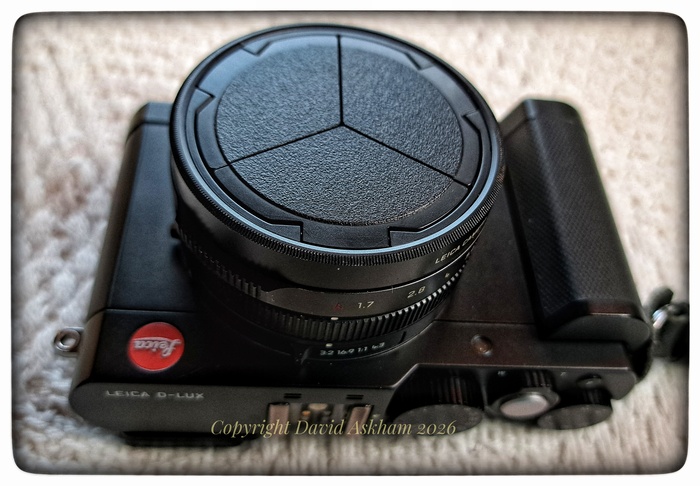
The lens stubbornly refused to extend
No, wait a minute. Eventually a message appeared on the screen hinting that there was a problem with extending the lens, but with no suggestions as to what I should do. The display of the battery status had not been reached. So I replaced the battery with a spare that had been fully recharged and powered up the camera again. Still the same message. The lens would not extend. I tried gentle shaking and fairly serious modest jolting, all without success.
It was time for some rigorous Googling!
The AI-inspired answer summarised a number of possible causes, ranging from the ingress of dust, or other foreign bodies, entering the lens extension mechanism; right up to a failed drive motor which would likely incur a repair cost in excess of the camera's replacement value. Uggh!
When I expanded the answer further, there was a step-by-step explanation of potential diagnoses.
The measure which caught my attention was as follows. Remove both the battery and memory card and leave the camera untouched for at least one minute. Which I did.
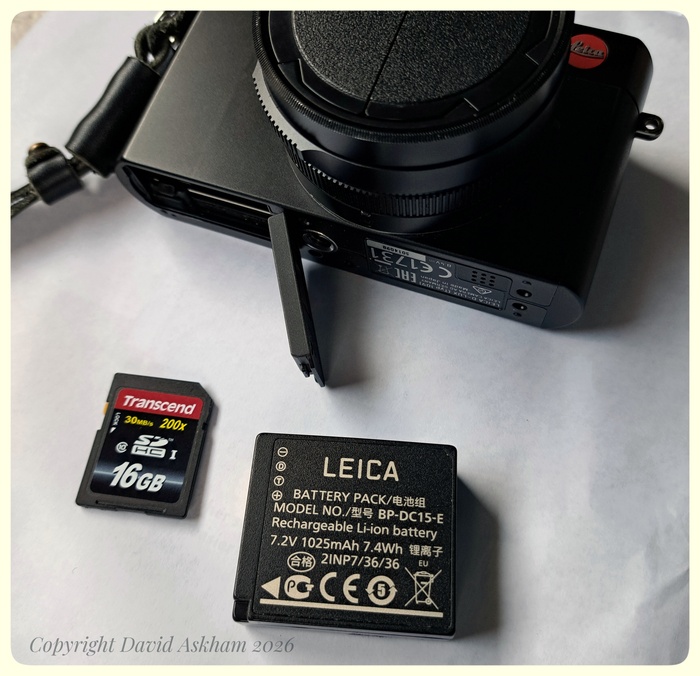
Camera with battery and memory card removed
When I replaced both battery and memory card, powered up, and much to my relief, the lens extended. I powered down, paused, powered on again. Yes, it worked. Time to rejoice and convince my ‘alter ego’ that I did not have a need to order a new D-Lux 8!
And I haven't!
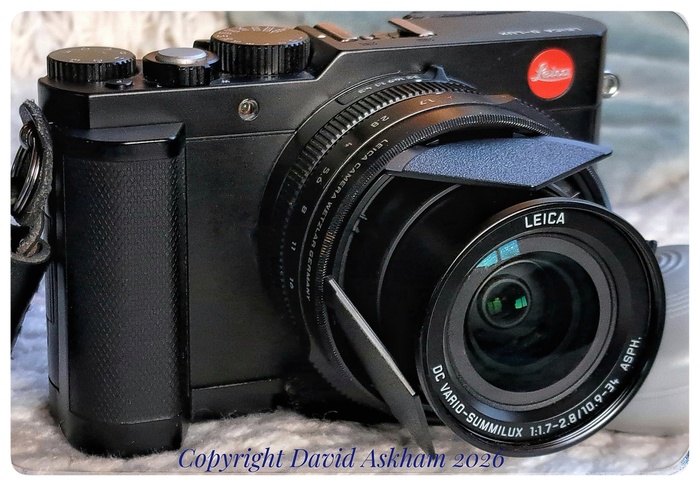
Leica D-Lux Typ.109 with lens extended ready for shooting. Note the essential accessory, a self-operating lens cap, which I consider to be better than a lens cap attached to the camera by a cord.
Major take-away
Without a shadow of doubt, the main conclusion has to be that an immediate action when a camera misbehaves is to remove both battery and memory card for longer than a meagre moment. One minute, at least. But please, don't ask me why? (Though maybe it allows a component on the integrated circuit motherboard, like a capacitor, to lose its charge slowly. An analogy is when you use a remote controller to turn off the TV. The light on the set continues to glow for several seconds, suggesting that you have failed to turn off the TV!)
The second lesson learned was to exercise your serviceable digital cameras regularly. It sounds obvious enough, but unless you schedule this task, it won't happen. Be serious and be surprised by your results.
If you do not intend to use your older camera, remove the battery and recharge it periodically. It should not be allowed to discharge completely. Replace the battery annually to check that your camera still works.
Now to do some serious testing on the D-Lux Typ.109. My little D-Lux deserves to shine again. I have included a selection of pictures to show the performance and versatility of this compact Leica camera. As it possesses an inbuilt electronic viewfinder, and a useful fast zoom lens, it surpasses a smartphone camera in terms of usefulness.
Perhaps I should now start to resolve the problem with a run-away shutter in my much-loved old Leica M8.

A modern development on the site of a former factory in Snuff Street, Devizes, Wiltshire

You never know when you will have the opportunity to capture a picture of a beautiful small tortoiseshell butterfly. (The image has been heavily cropped to avoid disturbing this shy creature)

Ornamental crab-apples.

"Won't anyone let me in?" (Shot through a double-glazed door)
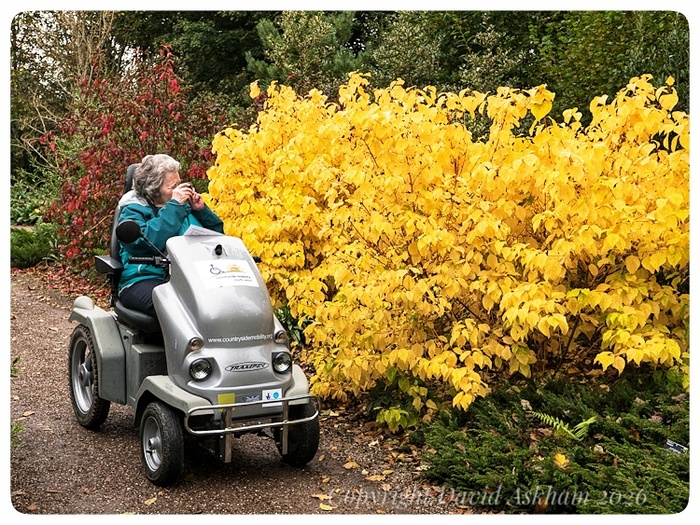
Mobility for an elderly visitor to an Autumn garden in Devon.
Images of the camera featured in this article were taken on a mid-range Galaxy smartphone camera. All other pictures were taken with my Leica D-Lux Typ.109 and picked to show its potential. All photographs were processed, framed and resized, using Snapseed software displayed on a Samsung Galaxy tablet
OH, YES, that was a real occurrence. Not imagined. It really happened. I even considered, momentarily, what new camera I might choose to replace it. So, how did the day unfold?
Traditionally, at the start of a new year, I revisit my older and lesser-used Leica cameras. This year I chose to bring out of retirement my old D-Lux Typ.109 for a little gentle exercise. I was in for a real shock.
Leica D-Lux Typ.109
Why I chose this camera is another story, but briefly, I had recently enjoyed reading an old library book on landscape photography featuring the legendary Joe Cornish at work in his chosen environment. It was published 16 years ago and witnessed Joe's transition from film to digital photography. One of the cameras he used, in addition to his large format film camera, was the Panasonic Lumix equivalent of the Leica D-Lux 3, and his results were surprisingly good, frequently filling a full page or more. A master photographer appreciated the virtues and capabilities of a modest little compact camera, which just happened to be equipped with a Leica lens. Being more portable, he used it primarily for researching compositions and angles of view. I use mine as a ‘beltable’ general-purpose ‘grab and go’ sort of camera.
The Leica D-Lux Typ.109 is equipped with a very fine and fast Vario-Summilux lens.
The D-Lux Typ.109 is my one and only surviving member of this illustrious line, an earlier model having been given to a granddaughter, who showed interest in amateur photography. My D-Lux has served me well, was in production for many years, and frequently travelled with me prior to the Covid-19 outbreak. Less so since. But this was its day for renewed photographic activity.
Unexpected revelation
However, when I switched on the power, nothing happened. Zilch! My heart sank!
The lens stubbornly refused to extend
No, wait a minute. Eventually a message appeared on the screen hinting that there was a problem with extending the lens, but with no suggestions as to what I should do. The display of the battery status had not been reached. So I replaced the battery with a spare that had been fully recharged and powered up the camera again. Still the same message. The lens would not extend. I tried gentle shaking and fairly serious modest jolting, all without success.
It was time for some rigorous Googling!
The AI-inspired answer summarised a number of possible causes, ranging from the ingress of dust, or other foreign bodies, entering the lens extension mechanism; right up to a failed drive motor which would likely incur a repair cost in excess of the camera's replacement value. Uggh!
When I expanded the answer further, there was a step-by-step explanation of potential diagnoses.
The measure which caught my attention was as follows. Remove both the battery and memory card and leave the camera untouched for at least one minute. Which I did.
Camera with battery and memory card removed
When I replaced both battery and memory card, powered up, and much to my relief, the lens extended. I powered down, paused, powered on again. Yes, it worked. Time to rejoice and convince my ‘alter ego’ that I did not have a need to order a new D-Lux 8!
And I haven't!
Leica D-Lux Typ.109 with lens extended ready for shooting. Note the essential accessory, a self-operating lens cap, which I consider to be better than a lens cap attached to the camera by a cord.
Major take-away
Without a shadow of doubt, the main conclusion has to be that an immediate action when a camera misbehaves is to remove both battery and memory card for longer than a meagre moment. One minute, at least. But please, don't ask me why? (Though maybe it allows a component on the integrated circuit motherboard, like a capacitor, to lose its charge slowly. An analogy is when you use a remote controller to turn off the TV. The light on the set continues to glow for several seconds, suggesting that you have failed to turn off the TV!)
The second lesson learned was to exercise your serviceable digital cameras regularly. It sounds obvious enough, but unless you schedule this task, it won't happen. Be serious and be surprised by your results.
If you do not intend to use your older camera, remove the battery and recharge it periodically. It should not be allowed to discharge completely. Replace the battery annually to check that your camera still works.
Now to do some serious testing on the D-Lux Typ.109. My little D-Lux deserves to shine again. I have included a selection of pictures to show the performance and versatility of this compact Leica camera. As it possesses an inbuilt electronic viewfinder, and a useful fast zoom lens, it surpasses a smartphone camera in terms of usefulness.
Perhaps I should now start to resolve the problem with a run-away shutter in my much-loved old Leica M8.
A modern development on the site of a former factory in Snuff Street, Devizes, Wiltshire
You never know when you will have the opportunity to capture a picture of a beautiful small tortoiseshell butterfly. (The image has been heavily cropped to avoid disturbing this shy creature)
Ornamental crab-apples.
"Won't anyone let me in?" (Shot through a double-glazed door)
Mobility for an elderly visitor to an Autumn garden in Devon.
Images of the camera featured in this article were taken on a mid-range Galaxy smartphone camera. All other pictures were taken with my Leica D-Lux Typ.109 and picked to show its potential. All photographs were processed, framed and resized, using Snapseed software displayed on a Samsung Galaxy tablet
END
(Copyright David Askham 2026)
(Copyright David Askham 2026)
Comments
 By Ken Davis: Thank you David, not only for the sound advice but also the Corporal Jones instruction - Don't Panic!
The photos show you both in action very well.
The 1 minute rule is a standard thing with any 'computer'. The buffer memories may still contain instructions if you just switch off and back on, leaving it at least a minute lets these clear down. By Keith Walker: A nice tale and some excellent images. Cameras or computers, it is wonderful what can be solved by disconnecting power source and letting the capacitors drain. Thanks for sharing. By David Askham: Ken and Keith, thank you for your kind comments. It is my hope that my article will serve as a useful reference for members who suffer similar anguish in the future.
By Ken Davis: Thank you David, not only for the sound advice but also the Corporal Jones instruction - Don't Panic!
The photos show you both in action very well.
The 1 minute rule is a standard thing with any 'computer'. The buffer memories may still contain instructions if you just switch off and back on, leaving it at least a minute lets these clear down. By Keith Walker: A nice tale and some excellent images. Cameras or computers, it is wonderful what can be solved by disconnecting power source and letting the capacitors drain. Thanks for sharing. By David Askham: Ken and Keith, thank you for your kind comments. It is my hope that my article will serve as a useful reference for members who suffer similar anguish in the future.