The Lure of Local Landscapes by David Askham 2025
04th December 2025
In: News, Members' Articles
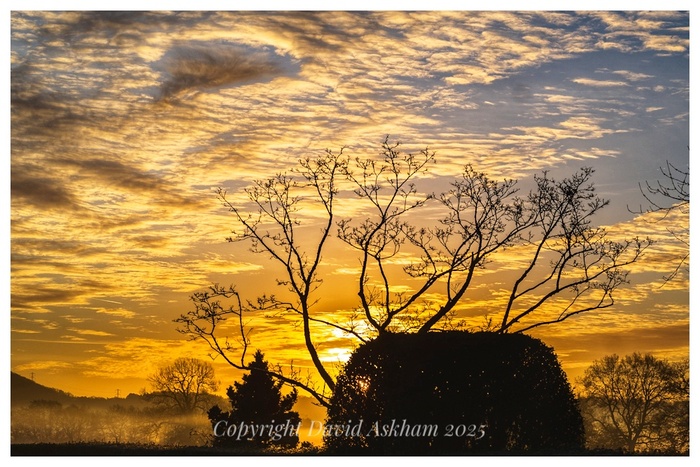
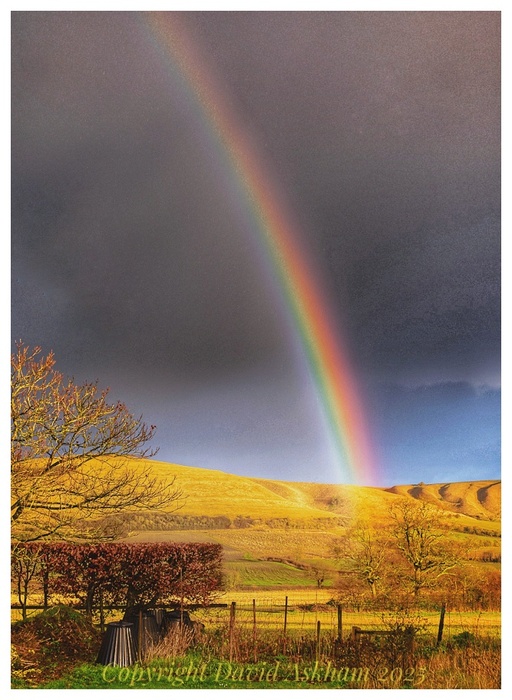
This dramatic landscape was taken from my garden which provided ideal foreground interest. (Leica Leica CL + 50 mm Summilux)
The Lure of the Local Landscape
By David Askham
By David Askham
During the last few years, certainly since Covid-19, my local landscapes have become ever more important to me. I wake up in the mornings, open the curtains, and glance at the view from my window. I know instantly what sort of day to expect. Wet and windy, or dry and fine? I can also tell whether it is worthwhile taking the camera out to capture a masterpiece, or more likely, to improve my rusty landscape photography techniques.
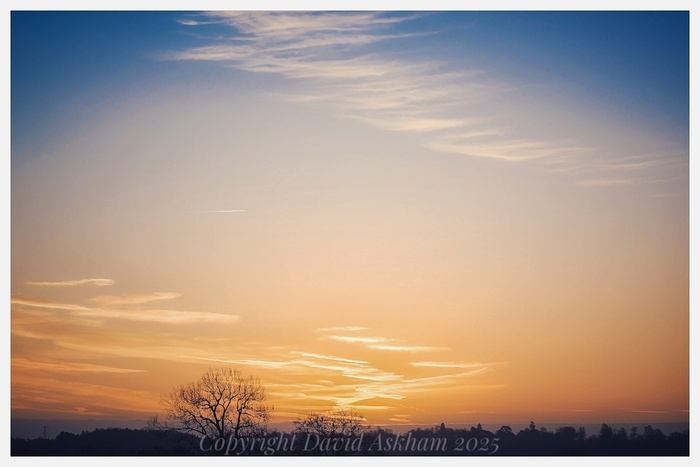
Ephemeral tones need to be captured quickly before they melt away. (Leica CL + 75 mm f2.5 Summarit)
Sometimes, it is instant reaction as the ephemeral hues of a breaking dawn skyscape require urgent capture before it is too late. There is no time for thinking or searching for the best instrument. So, I use whatever camera falls to hand, all too often a smartphone. Increasingly, I find that the phone camera is used as a stepping stone to the use of a Leica. The latter is superior and is much more pleasant to use.
I am not alone in working this way. During reconnaissance trips to woodlands, many professional landscape photographers use phone cameras to document precise locations of scenes which have potential in another season, or with more appropriate lighting or weather conditions.
However, notwithstanding their usefulness, I have taken to keeping a Leica camera handy at home, increasingly, for these rare short-lived opportunities. The Leica invariably yields superior results.
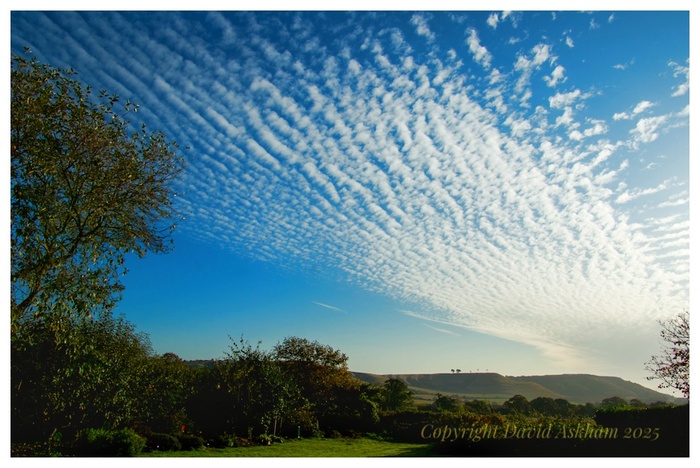
A mackerel sky, one of the most popular cloud formations and deserves to be part of my story. Usually a herald of fine weather.
Skyscapes
In early mornings, ever-changing skies are the main targets. Capturing skyscapes successfully calls for skills both in timing and composition. Skies invariably change constantly. There are new potential pictures every few seconds.
An understanding of meteorology also helps, particularly with cloud types. Recognizing the difference between cirrus and cumulus clouds and its relationship with current, and soon-to-be-experienced weather conditions. Cirrocumulus clouds form the basis of ‘herringbone’ or ‘mackerel’ skies and can herald the impending arrival of a warm front in your area. Whereas cumulo-nimbus clouds threaten thunderstorms. They are often impressive.
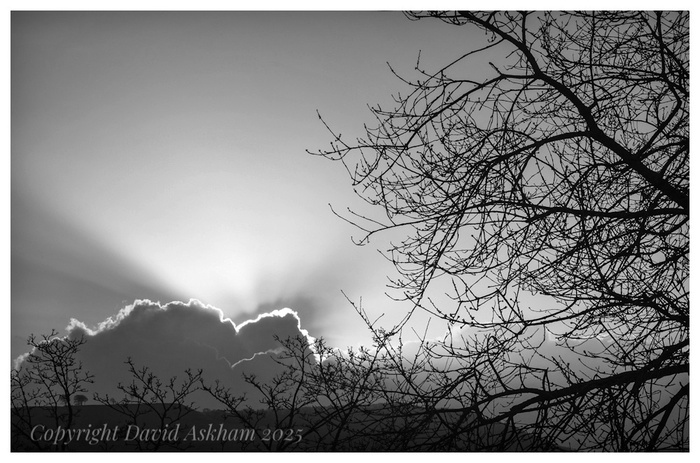
Drama at dawn over the Downs. Such a transient effect needs a quick response, captured here in monochrome. (Leica X-Vario)
When photographing early morning or dawn skies, exposure determination is fairly straightforward. The dynamic range is well within a modern sensor’s capability. However, if you include landform at the base, you might need to make adjustments in post-processing.
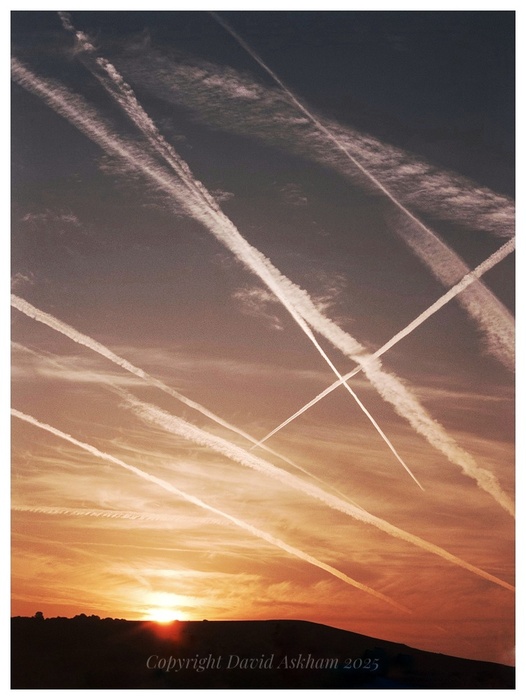
Before Covid, contrails were a common sight at dawn. Much less so nowadays, possibly due to global warming which warms the upper air levels denying the formation of contrails. (Leica Digilux 2)
Landscape opportunities
There is a temptation to believe that the ‘grass is always greener’ over the horizon. Stunning pictures in foreign places bear testimony to that belief. But most of us are unlikely to visit such locations, so we must make the most of what we have locally. Which brings me back to the view from my window. What can I discover on our horizon?
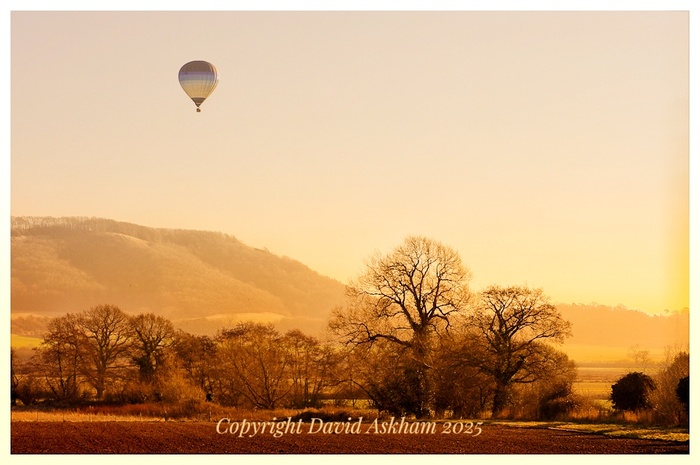
Hot air balloons drifting across our landscape was a common sight 35 years ago, causing local dogs to bark at them. They are very rare today. Here I have presented the scene in sepia to hint at a bygone age.
My view from our home looks onto the western edge of The North Wessex Downs. That is where the sun mostly rises, depending on the season. It is not a majestic range of famous mountains. Just a gentle escarpment separating an elevated plateau from a very fertile shallow valley floor. In prehistoric times, there is evidence to suggest that our broad valley was once a seabed, hence its undoubted fertility. Little wonder that our village is renowned for its market gardens and farming, of which there were about ten farms within our hamlet alone. But back to my view.
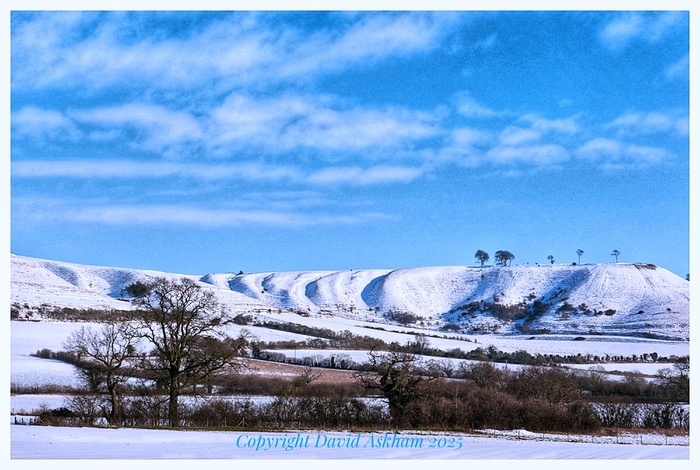
Snow on the Downs was once a common sight in winter. Less so today. Note how the ravines are accentuated by the snow and side lighting. ((Leica M8 + 75 mm Summarit)
A feature of the escarpment is a series of ravines or short gullies. Some thought these gullies were the result of melting icebergs at the end of the ice-age, during a previous era of global warming. I am beginning to doubt that theory, believing that natural erosion, by wind and water, and lack of hillside cultivation is a more likely explanation. Whatever the cause, under glancing sunlight they become a very interesting feature to photograph. And after snowfall, they add interest to the summit of the Downs, at least to my eyes.
There is another surprising facet to these Downs. Just over the escarpment rim, where the upper plateau starts, are the locations of two significant historic sites. The older is the site of an iron-age fortified village, of which there is little, or no trace, now. The more recent one relates to the English civil war, (AD 1642 to AD 1651), the Battle of Roundway, a village on the outskirts of Devizes. For many years a local village public house was called ‘Oliver Cromwell’ until it was taken over as an Asian restaurant and renamed "The Coconut". (I can assure you that coconuts are not grown in this part of Wiltshire!) Perhaps we are witnessing the start of a new phase of British history.
Vegetation and wildlife
A landscape devoid of vegetation is a desert, well beyond my experience in Wiltshire. My local vista contains a very narrow stream, feeding eventually into the river Avon which meanders westwards towards the Bristol channel. Self-seeded native trees proliferate along this water course, adding to the interest in ‘my’ local landscape. But all of this is about ½ mile away and the stream is hidden by verdant growth.
Most of the trees are deciduous, rendering my vista an ever-changing abstract of shapes and colour. Just before last summer's drought, the Forestry Commission engaged contractors to replace lost hedgerows with new native saplings. The aim was to create a new national forest in ribbon form, affecting many adjoining counties, to replace those lost trees over time.
Although I am not a wildlife photographer, mention should be made of creatures we have seen from our home. Some even stray into our garden and include hares, hedgehogs, muntjacks and wild birds galore. But that's a topic for the future.
The nature of farming fields has changed in the 40 years of our presence. Grass for silage to feed cattle; market gardening; grain for combined harvesters to process and vegetable crops are slowly giving way to acres of sweetcorn for conversion locally into gas fuel to meet national energy demands. Is there a risk that we are losing our independence to feed ourselves? Who said landscapes are boring? Happily our local meadow is occasionally used for sheep grazing, but not the rare breed - the Wiltshire Longhorn with beautiful long curled horns - last seen here thirty years ago.

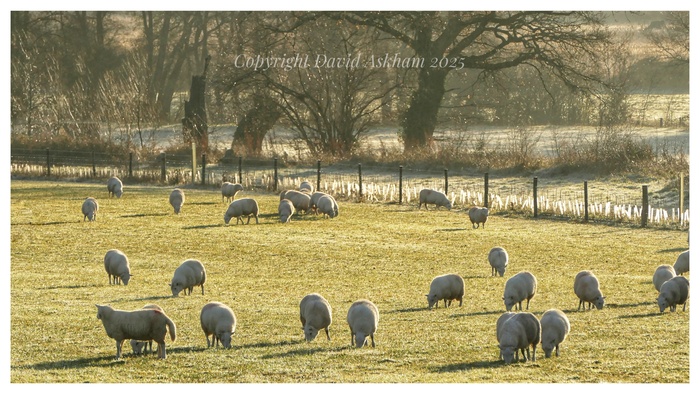
Once a very common sight; less so today. However, a temporary appearance of a 100 strong flock of another breed suddenly appeared as I was concluding this article. Beyond the sheep in the top image, you can glimpse the tree line and mixed self-seeded vegetation flanking the banks of the little stream that flows constantly. The lower image was taken early morning at a later date. (CL + Tele-zoom and V-Lux typ.114)
Where to aim my camera?
A landscape is often defined by its skies. They are constantly changing and evolving. Skies change more quickly, depending on weather and temperature, than does the surface of our earth.
A quick capture slightly dramatised in post-processing. (Leica CL + 50 mm Summilux)
Human beings come and go; terra firma is more permanent. As photographers, our view is but a snapshot of time. Choose that timing wisely.
Increasingly I have found that a tele-zoom can be so useful when looking for impressive landscapes. It is possible to find pictures within expansive landscapes. (See the shot above with sheep) And lighting makes or mars a scene. Frequently, it becomes necessary to schedule a shot when the light is right. That is easier when you are working locally.
I hope that the analysis of my local landscape will inspire you to look more critically at yours. And yes, I have lived in cities where the rooftop landscapes can be much less inspiring, apart from the skies above them. Just consider the famous British artist L. S. Lowry who found inspiration in his industrial cityscapes in northern British cities. His childlike style has endured through time and captured the good and the bad of that industrial era.
I have used a variety of mostly Leica cameras to illustrate this article. But the Leica CL, with standard and telezooms, is outstanding and highly relevant for my current needs.
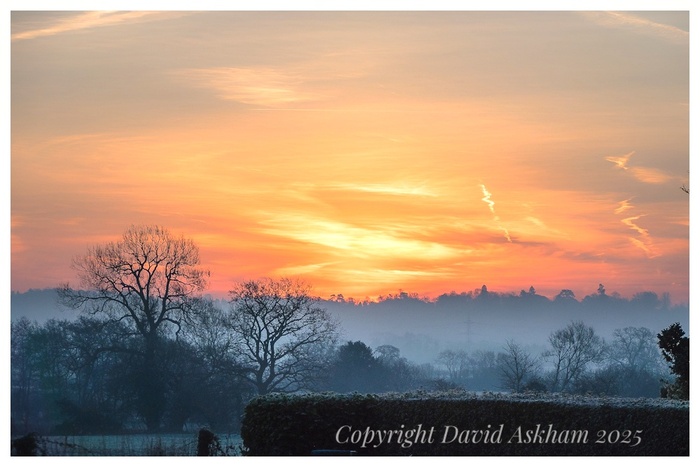
Mist is highly popular with landscape photographers as it can hide or transform landscape features. It soon burns off in my local landscapes, so you have to capture it quickly. (Leica V-Lux Typ.114)
Be inspired.
Look and see what you can find.
Throughout the varied seasons, you may be very surprised by what you find in your local landscape!
Look and see what you can find.
Throughout the varied seasons, you may be very surprised by what you find in your local landscape!
(Text & Pictures Copyright David Askham 2025)
Comments
 By Sue Lawler: An inspiring article. Why didn't I take hold of these opportunities with understanding when living a few miles away from Roundway some years ago? Now is perhaps the time to start locally, 250miles away from there . . . . . . Watch this space! By Cled Lewis: Beautiful, a selection of skies to delight the eye.
The combination of light and composition makes each image a winner and an inspiration to try to achieve something similar.
The B&W picture is striking and it is difficult to choose a favourite.
Cled By Keith Walker: You are absolutely correct, there is much to photograph in our local area, enhanced with the changes we enjoy through the seasons. Don McCullin's b&w (Somerset) Landscapes are all taken within half a mile of his house - seen the exhibition and have the book, excellent as you would expect.
I find the large typeface 'Copyright' on every image a distraction, and it dominates image five. Just IMHO of course! By Ken Davis: David, you describe a subject that is close to my heart.
You found some excellent landscapes around your home and you exploited the time of year and day to maximise their impact.
Traditionally we have all loved going to 'exotic' locations and bringing home photographs from these places. However, as you say, age and infirmity may prevent such journeys. However, if you can get out just a little way you can still find suitable subjects.
I have had to do this for a few years and it has the added benefit of teaching you to look anew at what is around you and make good landscapes from what you think is 'the ordinary'. By David Askham: Sue, it is heart-warming to read that you found my article 'inspiring'. Documenting scenes that are susceptible to change can be very rewarding when viewing them a few years later.
Cled, Thank you for your comments on my illustrations. I try to select them to illustrate my words, as well as well as being pleasing to the eyes.
Keith, thank you for your comments. I am sorry that my credits spoiled your appreciation of my illustrations. I have adjusted the contrails picture and substituted a new version,
Ken, It is good to know that I am not alone in having to adapt to practise my photography with impaired mobility. Frankly, I feel lucky to be alive, despite the challenges of modern life. Thank you for your encouraging comments. By Philip Rigby: David - some very inspirational and thought provoking images, amplified by your descriptive talents. I am another that is much restricted these days because of my wife's illness, hence the concentration on floral subjects, and the odd NT property. Your superb images, have encouraged me to lift up my eyes a little : philip By Malcolm Clarke: What big, open views of the sky you have David! For many years now, I have lived with views of trees changing almost from day to day in some seasons, though I still at times miss the openness of W. Cornwall where I spent my teens By Caroline Lewis: Wow, thank you for sharing your beautiful images David. The pictures are all so different even though you can see they are often the same range of hills. You really have painted with light. Beautiful! By David Askham: Philip, I am sure that I speak for all members when I say how sorry I am to learn of your restrained and sad personal life. Without making too many assumptions, I have a suggestion for your consideration. Embark on a pictorial retrospective of the highlights of your lives together. There are many benefits, for both of you, of looking at long-forgotten photographs. Each old picture allows you to relive past precious moments. It may help you to view this old article of mine (Sorry! Links to other websites are not allowed. Please search on my website (link is shown in LINKS below), and then search for My first photo-book) l have since produced many more such collections. I am willing to help you whenever you feel the need for an alternative view. Just ask me. And thank you for your generous comments on my latest article. By David Askham: Melcom, thanks for your comment. I do realize that some home-dwellers may not have the open skies that I enjoy. I have experienced that situation before settling in Wiltshire. However your local area surely gives you some access to open spaces? Parkland or rivers for example. But I would not dismiss your vista of trees. Many can be interesting in all seasons as they change colour and shed leaves leaving abstract skeletons. Also consider the birdlife. Apart from residents such as the inevitable robins, plantlife encourages migratory birds at the appropriate times. All is not lost. Capitalise on what opportunities you have. You will be rewarded. By David Askham: Caroline, thank you for your generous comments. I can tell that my pictures and words have meant something to you. I do hope that you are capturing pictures of your local area, which you would forgiven for thinking that ‘there is always tomorrow’. By David Askham: Malcolm Clarke, please forgive my mis-spelling above. Unfortunately there is no way to male corrections after posting.
By Sue Lawler: An inspiring article. Why didn't I take hold of these opportunities with understanding when living a few miles away from Roundway some years ago? Now is perhaps the time to start locally, 250miles away from there . . . . . . Watch this space! By Cled Lewis: Beautiful, a selection of skies to delight the eye.
The combination of light and composition makes each image a winner and an inspiration to try to achieve something similar.
The B&W picture is striking and it is difficult to choose a favourite.
Cled By Keith Walker: You are absolutely correct, there is much to photograph in our local area, enhanced with the changes we enjoy through the seasons. Don McCullin's b&w (Somerset) Landscapes are all taken within half a mile of his house - seen the exhibition and have the book, excellent as you would expect.
I find the large typeface 'Copyright' on every image a distraction, and it dominates image five. Just IMHO of course! By Ken Davis: David, you describe a subject that is close to my heart.
You found some excellent landscapes around your home and you exploited the time of year and day to maximise their impact.
Traditionally we have all loved going to 'exotic' locations and bringing home photographs from these places. However, as you say, age and infirmity may prevent such journeys. However, if you can get out just a little way you can still find suitable subjects.
I have had to do this for a few years and it has the added benefit of teaching you to look anew at what is around you and make good landscapes from what you think is 'the ordinary'. By David Askham: Sue, it is heart-warming to read that you found my article 'inspiring'. Documenting scenes that are susceptible to change can be very rewarding when viewing them a few years later.
Cled, Thank you for your comments on my illustrations. I try to select them to illustrate my words, as well as well as being pleasing to the eyes.
Keith, thank you for your comments. I am sorry that my credits spoiled your appreciation of my illustrations. I have adjusted the contrails picture and substituted a new version,
Ken, It is good to know that I am not alone in having to adapt to practise my photography with impaired mobility. Frankly, I feel lucky to be alive, despite the challenges of modern life. Thank you for your encouraging comments. By Philip Rigby: David - some very inspirational and thought provoking images, amplified by your descriptive talents. I am another that is much restricted these days because of my wife's illness, hence the concentration on floral subjects, and the odd NT property. Your superb images, have encouraged me to lift up my eyes a little : philip By Malcolm Clarke: What big, open views of the sky you have David! For many years now, I have lived with views of trees changing almost from day to day in some seasons, though I still at times miss the openness of W. Cornwall where I spent my teens By Caroline Lewis: Wow, thank you for sharing your beautiful images David. The pictures are all so different even though you can see they are often the same range of hills. You really have painted with light. Beautiful! By David Askham: Philip, I am sure that I speak for all members when I say how sorry I am to learn of your restrained and sad personal life. Without making too many assumptions, I have a suggestion for your consideration. Embark on a pictorial retrospective of the highlights of your lives together. There are many benefits, for both of you, of looking at long-forgotten photographs. Each old picture allows you to relive past precious moments. It may help you to view this old article of mine (Sorry! Links to other websites are not allowed. Please search on my website (link is shown in LINKS below), and then search for My first photo-book) l have since produced many more such collections. I am willing to help you whenever you feel the need for an alternative view. Just ask me. And thank you for your generous comments on my latest article. By David Askham: Melcom, thanks for your comment. I do realize that some home-dwellers may not have the open skies that I enjoy. I have experienced that situation before settling in Wiltshire. However your local area surely gives you some access to open spaces? Parkland or rivers for example. But I would not dismiss your vista of trees. Many can be interesting in all seasons as they change colour and shed leaves leaving abstract skeletons. Also consider the birdlife. Apart from residents such as the inevitable robins, plantlife encourages migratory birds at the appropriate times. All is not lost. Capitalise on what opportunities you have. You will be rewarded. By David Askham: Caroline, thank you for your generous comments. I can tell that my pictures and words have meant something to you. I do hope that you are capturing pictures of your local area, which you would forgiven for thinking that ‘there is always tomorrow’. By David Askham: Malcolm Clarke, please forgive my mis-spelling above. Unfortunately there is no way to male corrections after posting.